


Before You Scale: Five Questions Every Medtech Founder Should Answer with Melissa Muller
Updated: Oct 4
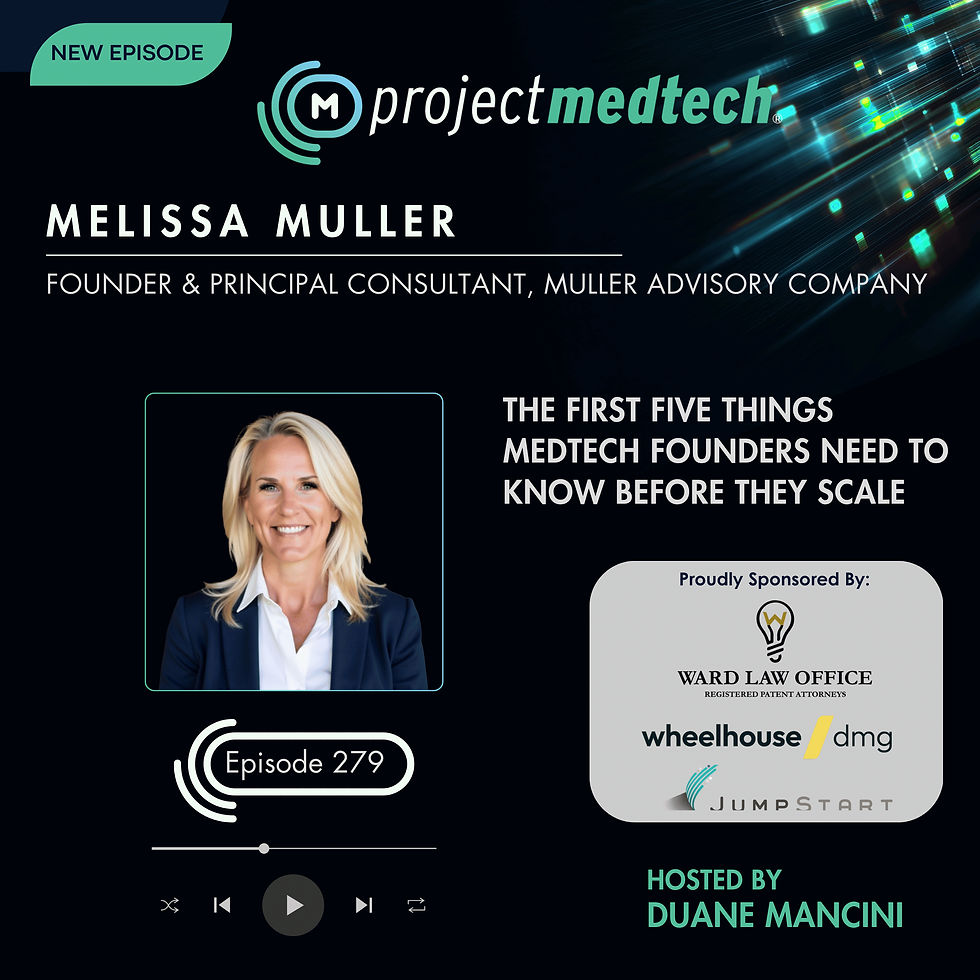
Getting a medical technology into its first hospital or finding those first enthusiastic adopters can feel like the finish line. In reality, it is often the beginning of a much more complicated challenge: scaling adoption. For Melissa Muller, founder and principal consultant of Muller Advisory Company, scaling requires founders to look beyond whether clinicians like their technology. With nearly 30 years of healthcare experience spanning both the buying and operating sides of major medtech companies, Melissa brings a unique perspective on what it actually takes to move technology into broader healthcare adoption.
Adoption Is More Than FDA Clearance
One of Melissa's biggest points is that regulatory clearance and adoption readiness are two very different things. FDA clearance gives a company permission to sell its product. It does not guarantee that a healthcare system will actually use it. To achieve adoption, founders need to understand three interconnected areas: the clinical, financial, and commercial stakeholders. Melissa compares the process to an Ironman: “You have to swim, you have to bike, and you have to run.” Clinical enthusiasm may get you into the race, but understanding the financial and commercial sides is what helps you finish it.
Map the Entire Workflow
The next question is deceptively simple: What changes when your technology is introduced? Founders need to look beyond the procedure itself and understand the entire workflow surrounding their product. That can include setup, teardown, IT involvement, biomedical engineering, reprocessing, procurement, and everything that happens before and after the clinical interaction. Melissa shared an example of an innovative technology that surgeons loved, only to encounter unexpected challenges when the device reached central sterilization. The lesson is straightforward: “Anytime you're introducing something new, you're creating friction and you're creating change.” Understanding where that friction exists, and for whom, can make the difference between enthusiasm and adoption.
Who Can Say Yes and Who Can Still Say No?
A clinical champion isn't necessarily the buyer, and the person who approves a product may not control implementation. Before scaling, founders need to identify the entire decision-making ecosystem: users, champions, approvers, budget owners, implementation owners, and, critically, anyone with veto power. A product can offer significant clinical benefits and still face a “no” because of contracting structures or financial considerations. Melissa points to the example of a new intraocular lens that could deliver excellent patient outcomes but potentially disrupt the cost-per-case economics of an ambulatory surgery center. Understanding what your technology displaces is therefore just as important as understanding what it improves.
How Does the Customer Actually Pay?
Reimbursement is only part of the financial equation. Founders also need to understand whose budget pays for the product, how the existing technology or procedure is funded, what contracts are already in place, and how procurement decisions are made. A technology might save significant clinical time but still require a department to create an entirely new budget line. That's a different conversation, and founders need to be prepared to make the economic case for why the change is worthwhile. The question isn't simply, “Will someone pay for this?” It's “Who pays, how do they pay, what are you replacing, and why is changing worth it?”
What Happens After First Use?
Getting the first use is exciting. But first use doesn't necessarily translate into sustained adoption. Melissa emphasizes the importance of staying close to early customers and understanding what happens after implementation. Moving from an academic medical center to a community hospital, for example, can introduce entirely different workflows, resources, and operational constraints. Those early customers are also an opportunity to identify unexpected friction and create advocates who can become champions for broader adoption.
This is where Melissa's advice becomes particularly relevant for founders eager to scale: “Do not scale assumptions, test them.” Before expanding across an entire health system, make sure you understand what is happening in one department, one floor, or one site of care. Learn from the environment before assuming the next one will look the same.
Why This Matters
Scaling a medtech company isn't simply about selling more units. It's about understanding the healthcare ecosystem well enough to make adoption repeatable. That requires founders to think beyond the product itself and understand workflows, economics, decision-making structures, procurement, and the realities of different sites of care. It also means recognizing that the market itself can change. Procedures are increasingly shifting from hospitals into ambulatory surgery centers and, in some cases, other care settings. A technology built around one site of care needs to be prepared for those dynamics.
What to Watch
The ultimate test of scalability may be whether the company can succeed without the founder in every room. Early on, the founder's story and personal passion can create tremendous momentum. But sustainable growth requires translating that knowledge so a broader sales and implementation team can tell the story, navigate objections, and close deals independently. As Melissa puts it, founders need to “prepare for what's coming, but then also prepare for other people to tell your story as well.” Before you build a massive growth forecast, make sure you've earned the right to scale. Understand the customer. Test the assumptions. Find the friction. Build the advocacy. Then scale what you've learned.
To hear Melissa Muller's full conversation and dive deeper into the five questions medtech founders should answer before they scale, listen to the latest episode of the Project Medtech Podcast: https://www.projectmedtech.com/projectmedtechpodcast/episode/3a97100e/episode-279-melissa-muller-founder-principal-consultant-at-muller-advisory-company-the-first-five-things-medtech-founders-need-to-know-before-they-scale

Comments